
A $488,000 watch is hard to ignore. Add a clear sapphire cover, a mechanical tourbillon sitting in the middle, and the Jeff Koons style, and it starts to feel like a small art object.
That is the plan in the Hublot x Jeff Koons line, shown in September 2026. The Swiss brand and the American artist put out two watches that do not look alike at all. One is the playful Classic Fusion Balloon Dog. The other is the much more complex MP-14 Origin by Jeff Koons.
The MP-14 Origin is the main draw. Only 30 are being made. It costs $488,000. The build uses sapphire, titanium, white gold, diamonds, and blue sapphires. It also uses Hublot’s first automatic central tourbillon.
Still, the point goes past the headline number and the celebrity name. This deal reflects a shift in luxury watchmaking. Brands are now trying to win attention where engineering, collector appeal, and contemporary art meet.
Hublot x Jeff Koons Is Built Around Two Very Different Watches
The launch comes with a pair of watches, and each one views Koons from a different angle.
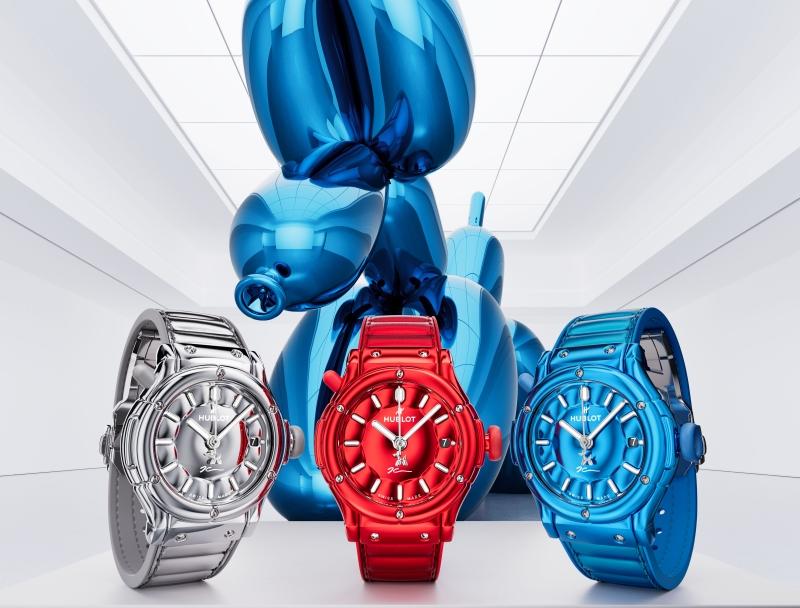
The first model is the Classic Fusion Balloon Dog. It stands out right away. It draws from Koons’ Balloon Dog sculptures and turns the shiny, blown up look into a 42mm watch for the wrist.
You can buy it in red, blue, or silver. Each color is capped at 200 pieces. The U.S. price for all of them is $25,100.
Hublot did more than put a Balloon Dog image on the dial. The studio changed the real parts of the watch to match Koons’ look.
The crown is shaped like a valve used to inflate balloons. A soft tail runs off the case near 10:30. A small Balloon Dog also shows up as the counterweight for the seconds hand. Inside the movement, the moving weight uses rounded shapes too, so the theme stays consistent.
Overall, the watch feels fun on purpose.
The MP-14 Origin, in contrast, steers the deal toward a more technical and higher end direction.
Why the $488,000 MP-14 Origin Costs So Much
The cost of the MP-14 Origin is not just about Koons.
This is a complex watch in the high horology world. It centers on Hublot’s first automatic central tourbillon. The case measures 44mm and mixes sapphire and titanium. The finish is not plain either. It uses gem-set white gold, diamonds, and blue sapphires. Hublot says only 30 watches will be made.
The movement is the Hublot HUB9014. It uses 594 parts. Hublot lists about 60 hours of run time.
Around the tourbillon, you also get layered circular forms. They give a sense of depth, like a tiny space you can look into. Time is shown with cubes that float. There are no typical hands in the middle area. The design also keeps the center looking open.
The sapphire outer part does more than show what is inside. It also acts as part of the main structure.
Hublot says the sapphire case takes about 534 hours to machine.
All of that makes the $488,000 figure easier to understand. This is not a basic Hublot with a Koons mark added at the end. The two sides had to adjust the case, the movement, and the way the watch presents the full idea from the artist.
Jeff Koons Brings the Language of Contemporary Art to the Wrist
Koons built his career by taking everyday things and shaping them into very controlled art.
His Balloon Dog pieces are the most famous case. A balloon animal that feels light and silly turns into something solid and mirror-like when it is made from polished metal. It also takes serious skill to pull off.
You can see the same push and pull in the Hublot project too. The playful side is kept, but the engineering is pushed far past what you would expect.
The Classic Fusion Balloon Dog uses the look in a direct way. The MP-14 Origin goes another route. It leans into Koons’ focus on light and reflection, and into the Gazing Ball works.
In the end, the watch is meant to feel more like a small sculpture. It tells time, but it does not feel like the usual kind of timepiece.
That difference matters once you get into luxury.
Here, buyers are not picking a watch just because it keeps better time than a $500 smartwatch. They want craft. They want limited availability. They want the design. They also want the story that comes with the piece.
Hublot Already Had a History of Mixing Art and Watchmaking
This partnership was not made up on a whim.
Hublot has been building the idea for a long time. For years, it has leaned into mixing materials and skills that usually stay in separate lanes. The firm’s roots go back to 1980. Back then, it got attention for putting a precious metal case with a rubber strap.
Its work with creative people follows the same logic.
Hublot says it has teamed up with artists, architects, designers, and others since 2011. It calls this part of its larger “Art of Fusion” theme.
Koons matches that theme well.
His pieces often start with something plain or known. Then they shift how viewers see it. Hublot does a similar thing, but in watch parts and in design choices for the overall look.
So the deal works on a business level too. It is not only about a headline.
The Balloon Dog Watch Has a More Accessible Price Point
Saying a 25,100 watch is “easy to buy” sounds wrong for most people. Still, in ultra rich watch circles, the Classic Fusion Balloon Dog is not the same kind of item as the 488,000 MP-14 Origin.
Hublot makes each color in only 200 units. That means 600 watches total across the three shades.
The red and blue pieces have polished anodized aluminum cases. The silver model instead uses stainless steel. Every watch runs on the automatic HUB1710 movement made by Hublot, and it has a power reserve near 50 hours.
This setup lets Hublot appeal to different buyers within the same collab.
One model is for people who like Koons’ look but do not want to spend in the mid to high half million range. The other is aimed at the very top of the market, where limited supply and mechanical work matter most.
Scarcity Is Part of the Business Model
Numbers matter.
There will be just 30 MP-14 Origin watches. So the supply stays tight from the start.
In luxury circles, limited runs can raise interest. This is more likely when the watch pairs a well known creative name with detailed making.
Still, scarcity is not a magic fix. It only helps if the watch itself holds attention.
A limited edition does not always turn into a true collectible. Buyers decide after the first release whether it keeps its pull.
That is also why artist and luxury watchmaker partnerships can look smart on paper and still come with real risk.
The brand gains fast headlines, but it must also deliver a piece that feels right to people who collect art and people who collect watches.
Read fully “A Tiny Startup Helping Google Take On Nvidia Is Now Worth $18 Billion”
Why Luxury Watches Keep Moving Closer to Art
The Hublot and Jeff Koons watch deal points to a shift in how luxury sells today.
More high-end watches are now treated as design pieces. People also collect them, not just wear them to tell time.
One reason is the old logic behind pricey mechanical watches does not hold up as well.
A mechanical watch that costs $488,000 is not going to beat cheaper digital models for accuracy. It also loses on ease of use and daily features. So the price depends on other factors instead.
Those include the kinds of materials used, the way the parts are finished, the engineering work, how rare the piece is, and the name behind it. Cultural fit and past influence also matter.
Then there is the art link.
Some buyers may think of the Koons name as a creative message. Others may focus on the tourbillon as the key feature. Still others may mainly want the idea that only 30 were made.
So the same watch can fit into the luxury world in more than one way.
There Is a Business Strategy Behind the Spectacle
For Hublot, doing a project like this helps set the brand apart.
The luxury watch space is full of firms that tout complex parts, rare metals, and small runs. Because of that, you cannot rely on specs alone to get noticed.
Working with an artist like Koons brings Hublot into a wider cultural scene.
This kind of deal can reach people who care about modern art, but it can also pull in the usual watch crowd. It may even get coverage from outlets that do not normally write about mechanical details.
That kind of reach matters a lot for a luxury label.
A watch at $488,000 does not need to move in huge quantities. The fact that it exists can still help support the message that Hublot sits between engineering, style, and top tier luxury.
The Risk: When Art Becomes a Marketing Device
Luxury houses have a tricky path to walk.
Art tie-ins can land well when the maker’s own style truly shows up in the watch. When it does not, the result can feel like a simple sticker on a product that was already set.
With Koons, Hublot tries to steer clear of that weak fit. The brand changes the way the watches are built, not just the look on the outside.
In the Balloon Dog series, the design reshapes parts like the crown, the case, the seconds hand, and even the details inside the movement. The MP-14 Origin goes further. It creates a new visual setup around its central tourbillon.
How people judge these watches later is the key. They may be seen as true horology, or they may be treated mainly as art meant for luxury buyers.
Hublot Is Selling More Than a Watch
The MP-14 Origin costs $488,000, yet it feels less like a normal watch and more like a design statement. It shows what can happen when watch mechanics are paired with modern art.
You can see three things in it. It is rare like a collectible. It is engineered like a top mechanical watch. And it uses an art-style look that recalls Jeff Koons.
That mix is the whole aim.
Hublot does not have to turn this into a mass product. The goal is to set the brand near the high end of its own idea of what watch design can be.
The Classic Fusion Balloon Dog plays a similar role, just at a lower cost. It takes one of Koons’ best known images and turns it into something that fits daily wear.
Still, the key question is simple. Does this work create value that lasts? Or does it fade after the first wave of buzz?
For now, Hublot and Koons have made a watch that stands out. Only 30 MP-14 Origin pieces exist, each listed at $488,000. From the start, the scarcity is part of the plan. Even so, the bigger point is different. The watch suggests how far luxury makers will push when the product is no longer only about reading time, but also about keeping a piece of design, skill, and culture.