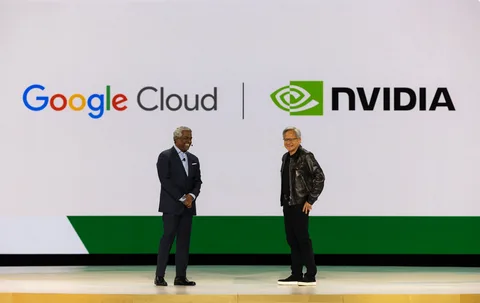

For years, AI builders have been competing in a tech-heavy arena. Big firms have stood out. Nvidia makes chips that run a lot of the work. Google is also working on its own approach, mostly out of view.
In that mix, Fluidstack has surfaced. It is not a household name. The firm started by renting GPUs to people doing AI research. Later, it landed major deals and got support through money and partner moves. That is part of why its value is now above $18 billion, tied to the growing demand for AI data centers.
What stands out is the speed. Fluidstack moved from low visibility to a role in the systems that major AI groups rely on.
How Fluidstack Went From GPU Rentals To AI Infrastructure
Fluidstack started in 2017. Gary Wu and Jamie Cox started it because they wanted a better link between people who needed compute and servers that were idle.
At first, the setup was straightforward. Some gamers and other users had strong GPUs but did not use them nonstop. On the other side, AI teams wanted access to costly compute. Fluidstack worked as a go-between for those two groups.
Over time, the plan grew.
When AI workloads started rising, the company took on managing big GPU clusters. After ChatGPT launched and AI demand jumped, Fluidstack shifted further toward running large computing systems for AI firms. In 2024, its revenue was said to have passed $66 million.
Later, the company changed focus again. It started paying more attention to data centres themselves.
Google Needs More Than Its Own AI Chips
Google has been working on its own AI chips for over ten years. They are called Tensor Processing Units, or TPUs.
For a long time, Google kept these chips for itself. Later, it also let customers use them through Google Cloud.
Now the goal looks wider. Google wants these chips to matter more in the AI market, even as Nvidia chips stay in a strong position.
That shift brings a tough setup problem.
Making the chips is not the whole job. Once you have them, you still need a lot of power. You also need cooling that fits the hardware. Data centers must make room. Then you need fast networking to keep workloads moving.
Fluidstack is stepping into that gap.
The startup has worked closely with Google on plans to place TPUs beyond Google’s own sites. Anthropic has also signed up to use Google’s TPUs at a large scale. The agreement mentions as many as one million chips for upcoming AI work.
Fluidstack is focused on making that gear work in real, day to day computing.
The $18 Billion Valuation
Fluidstack’s valuation has swung fast.
In July, the firm said it was raising $750 million. The deal valued it at $7.5 billion. Situational Awareness led it.
Not long after, Fluidstack took in another $1.5 billion. Jane Street led that round. Sources say the new money put the company’s value above $18 billion.
Such a leap hints at where investors are placing their money in AI work.
Some of the best chances might not be in the AI system itself. Back-end work also matters. Power, chips, data centers, and the compute needed to run models can drive big returns.
Fluidstack is making that same bet.
Its Biggest Advantage Is Speed
Building a data center usually takes a long time. There is planning, approvals, and a lot of construction work.
Fluidstack says it can go faster.
A recent investor memo, according to reports, put numbers on what the firm expects to do. It said Fluidstack could handle about 1.3 gigawatts of power across more than 10 sites in 2026. The memo also pointed to revenue near $660 million. That would be more than three times the amount from the year before.
For the years after that, the memo laid out a bigger target. By 2030, it aims to manage over 17 gigawatts of capacity.
If those goals hold up, Fluidstack could rank among the larger independent firms tied to AI infrastructure.
The company’s way of working is not the same as CoreWeave or Nebius. Those firms mainly purchase Nvidia GPUs and then rent out access.
Fluidstack puts more emphasis on building and running the physical setup where the hardware sits.
That difference may matter more as AI teams try to get compute power sooner. Traditional data center builders often cannot deliver quickly enough.
Google And Anthropic Are Not The Only Customers
Fluidstack does not rely on one customer for its growth.
The team has worked with Meta and also with Jane Street and Black Forest Labs. In other work, it has handled big power and data-center efforts.
Anthropic stands out, though. It needs a lot of computing time and resources. Because of that, the firm keeps spreading its infrastructure across more than one hardware source. It uses Google, Nvidia, AMD, and Amazon Web Services.
This situation brings both upside and pressure for Fluidstack.
On the bright side, AI firms keep asking for more compute.
Still, those buyers can choose other options.
The AI Infrastructure Race Is Getting Expensive
Fluidstack’s quick growth is also expensive in a very direct way. It needs a lot of money fast.
To fund new data-center work, the firm and its partners have borrowed billions of dollars. At the same time, large tech companies are putting up bigger and bigger amounts of cash to lock in future computing.
This strain makes sense. AI systems need big spending at the start. A plant cannot earn much until it is built and running.
Power adds another layer of trouble.
These AI sites use a huge amount of electricity. In some places, the local power grid cannot take more loads easily. Fluidstack has been weighing options like sites tied to cleaner power sources and data-center setups that can be built in modules.
In Arizona, the company has also signed leases for over 1 million square feet spread across two buildings as it grows its footprint.
The rapid rise of companies like Fluidstack also shows how strategic investments can create enormous value, much like how sports teams can create billions in wealth for billionaire owners over time.
Nvidia Is Still The Giant In The Room
Even with Fluidstack tied to Google’s AI push, Nvidia is still hard to beat.
Nvidia is not just about the chips. CUDA has grown into a core tool for many AI teams. Once engineers build their workflows around it, swapping to a different processor is not simple, even if a rival option exists.
Google’s TPUs can offer a different route. Still, teams need the right setup and software support to make TPUs work well in real deployments.
Because of that, Fluidstack could matter more than just offering sites and power. If Fluidstack helps other AI hardware get used faster, firms may rely less on Nvidia.
There is a problem, though.
Nvidia has backed a number of AI cloud businesses. CoreWeave, Nebius, and Crusoe are examples. Fluidstack is not on that big list of investments, at least so far.
What Comes Next For Fluidstack
Fluidstack’s $18 billion valuation shows how quickly the tech world is moving.
The AI wave is not only about teams that train the most capable model. More often, it comes down to power and hardware. It also comes down to storage, data centers, and the compute needed to keep things running when demand spikes.
Fluidstack began as a lesser known GPU rental firm. Now it wants to be seen as part of the base layer that makes large AI systems work.
The company still faces big hurdles. Fast builds are one challenge. Steady operations, with good profit results at massive scale, is a different problem.
If AI usage keeps rising, the firms that supply the underlying systems may matter as much as the firms that build the AI.
For Fluidstack, this shift has gone from a small start to a $18 billion claim on what comes next in artificial intelligence.
The demand for massive computing infrastructure is also closely connected to the rise of physical AI, as companies prepare to power increasingly sophisticated machines, robotics and other AI-driven systems.