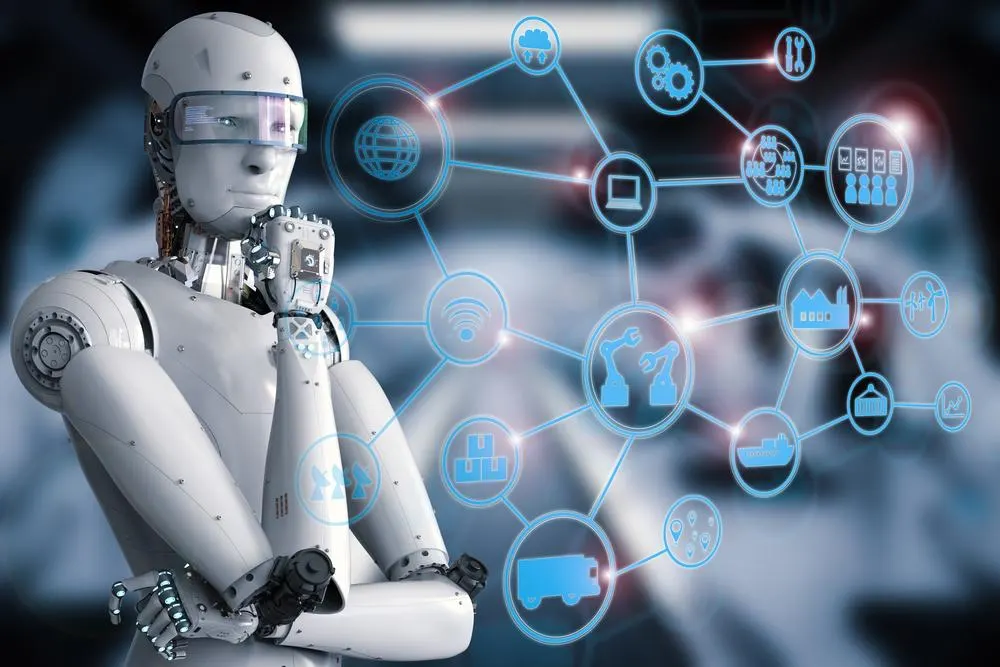

Robots have worked in factories for a long time. Still, many of them were made for one task and for tidy, predictable settings.
Now that picture is starting to shift.
Newer physical AI helps robots handle real-world messiness. They can use cameras and other sensors to gather what is going on. Then AI models help them choose what to do next, instead of only running a fixed motion plan.
If that keeps improving, robotics could move beyond a narrow shop-floor role. It may fit bigger markets like warehouses, logistics, health care, and building sites. In time, it could also reach ordinary homes.
What Is Physical AI?
Physical AI is built for tasks that touch the real world.
A chatbot can reply in a few seconds. A robot faces a tougher job. First it has to spot what is in front of it. Then it needs to figure out where things are. After that, it must deal with the space around it. Finally, it has to move in a safe way, without hitting objects or injuring people.
To do all of that, multiple pieces have to run at the same time. This includes computer vision. It also depends on sensors. Robotics parts matter too. On top of that, AI models are needed, plus fast real time processing.
More companies are aiming at systems that tie language to what the robot can see, and then to motion. NVIDIA is one example. It offers the Isaac robotics tools. It also has the GR00T model work. The idea is to let humanoid robots follow directions and carry out different physical actions.
The plan is big. Instead of writing new code for every move, the push is to train broad skills. Those skills should carry over to new scenes and new problems.
Robots Are Moving Beyond Repetitive Factory Jobs
Industrial robots can handle repeated jobs very well. They weld parts, put components together, and carry pieces quickly with steady results.
Still, that is only the start.
The larger chance is building machines for places that were made for people from the beginning.
Think about a robot that can grab many kinds of boxes in a warehouse. It could drive through layouts that change. It could also take on more than one job in the same work day. A body shaped like a person may help here. It might use shelves, tools, doorways, and stations that already exist. That could mean fewer changes to the building.
This helps explain why groups like Figure, Agility Robotics, and Boston Dynamics get a lot of focus.
Big tech firms are getting involved too. They bring chips, cloud services, and the AI tools that help these robots function.
People notice the machines first. But in the end, the code and learning approach may decide whether the robots are truly helpful.
The Money Behind the Robot Boom
Robotics is a huge market right now.
The International Federation of Robotics said 542,000 industrial robots were put to work worldwide in 2024. That figure is more than twice what was installed ten years earlier. Most of the new units were placed in Asia, at about three quarters of the total.
The same group estimated that nearly 4.66 million industrial robots were running globally in 2024. China accounted for over 2 million of those machines.
Physical AI may grow faster this space. It may not just swap out older automation.
Investors seem to like that angle.
A robot built for only one job does not bring much value outside that specific use. In contrast, a robot that can learn several tasks could be used across many parts of a company.
This setup may also lead to ongoing income. Firms could earn money not only from robot sales, but also from AI tools, updates, cloud access, repairs, simulation, and specific add on uses.
Teaching Robots Is Harder Than Teaching AI to Talk
People often mix up two different problems.
One is teaching a system to work with language.
The other is teaching a robot to deal with the real world.
Language work can rely on huge text sets.
Real robots learn by doing.
They must learn what goes wrong when something slides. They must learn how strong a grip should be.
They also have to learn what to do when a person steps into the way fast.
Getting data like that outside is hard. It can take a long time. It can also cost a lot. That is why people look at simulation.
In virtual worlds, robots can practice many actions. Sometimes the number is in the thousands. In some plans it could reach much higher than that. Firms are creating these test spaces for robot learning.
NVIDIA is one of them, and it has worked on simulation and synthetic data. Its work connects with tools used with the company’s GR00T robotics models. The goal is simple. Let a robot learn from errors on a screen. Then move it into a real factory only after it has the basics.
If the tools keep getting better, the training effort may get cheaper and faster.
Humanoid Robots Are Starting to Show Results
Humanoid robots still have a lot to prove, but there are clear hints they can do real jobs.
Figure said its Figure 02 unit ran at BMW’s Spartanburg plant for more than 1,250 hours. During that time, it handled over 90,000 parts.
In 2026, Figure brought its newer Figure 03 robot back to BMW. The company said it was used for a tougher logistics job that required both moving items and handling them with care.
None of this suggests humanoid robots will replace human workers in large numbers right away.
Still, the focus seems to be shifting. Firms are starting to push for answers to a practical question. Do these systems cut costs, raise output, or help with labor gaps?
That outcome will decide if physical AI turns into a lasting business tool or stays a costly trial.
The Risks Are Just as Real
A lot of people talk excitedly about physical AI, but the path ahead is not easy.
Money is a major issue. To build capable robots, teams need pricey parts. That includes sensors, motors, batteries, and the computers that run the system.
Another problem is trust. A robot in a plant cannot just “try again” like an app on a phone. If it fails, it must still keep working in a controlled way. It also has to stay safe near workers and costly gear.
Safety matters even more over time. As robots get stronger and can make more choices on their own, the risk grows. NVIDIA said it is building its Halos for Robotics plan in 2026. The goal is to meet safety needs for physical AI.
After that, there is the question of value.
A robot can look great in demos, yet still not pay off. Firms will weigh what they spend to buy, maintain, and oversee the robots versus what the robots actually deliver.
On top of that, the market may get crowded. The United States, China, Japan, and Europe all have major robotics sectors. At the same time, big tech firms are racing over the AI models, the chips, and the systems that support these machines.
The Next AI Market Could Be Physical
Physical AI might not hinge on whether robots look human.
The bigger shift is the chance to place AI in places the usual software world barely reaches.
Factories and warehouses come to mind. So do clinics. Construction sites, too. These spaces can turn into live labs for machines that can act.
The top gains may not go to firms that show off the flashiest robot designs. Some of the most valuable work could sit in the quieter parts of the stack. Think chips, sensors, batteries, motors, test and training tools for digital models, safety gear, and the AI models themselves.
The field is still growing. Several major claims have not yet been proved in the real world. Still, the path ahead looks pretty obvious.
The early AI wave changed what computers could do on a screen. This next effort aims to move that skill into the real world.
If it works, robots may not only get better at tasks. They might also become a key business platform for the coming years.