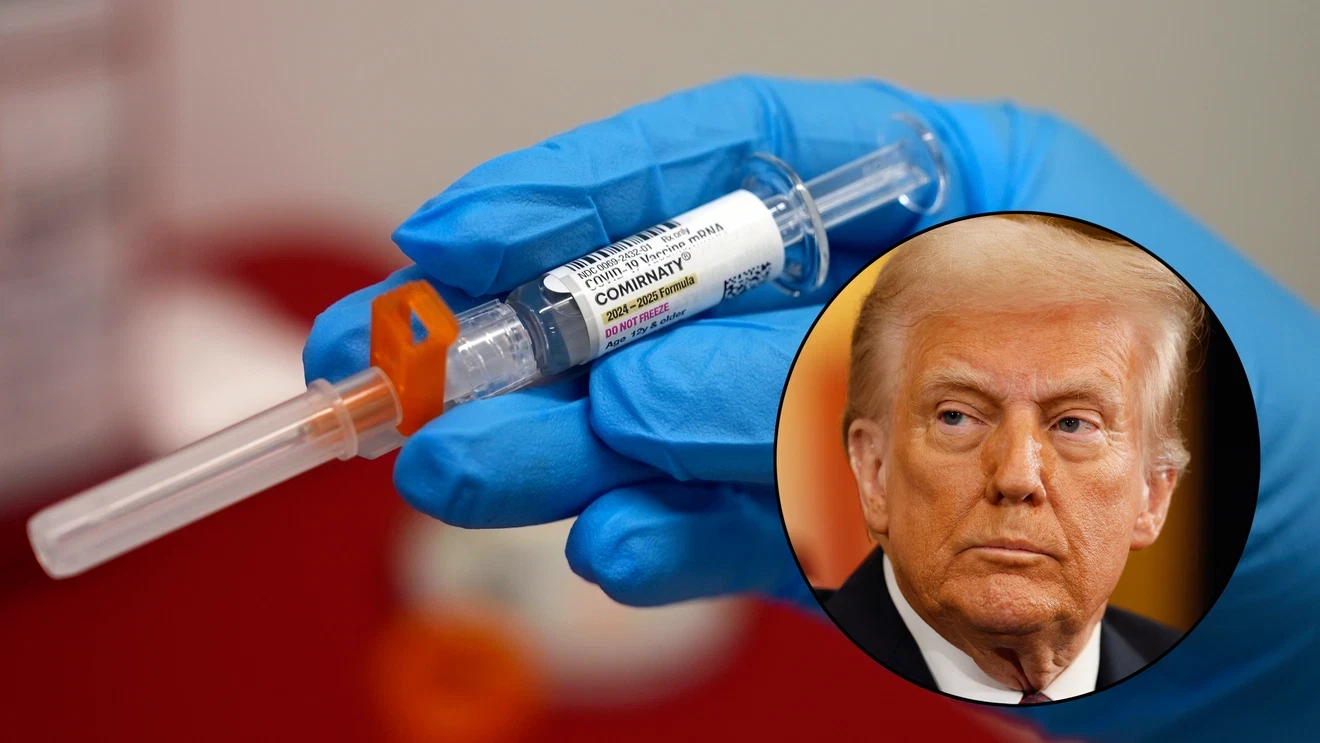

For the second time in as many days, vaccines are the subject of a national health care debate in the United States, with President Donald Trump once again calling them into question.
Trump signed an executive order on Aug. 10 calling for federal agencies to reconsider childhood vaccine recommendations, which includes the possibility of fewer immunizations routinely recommended for children and, eventually, the splitting up of the combined measles, mumps and rubella (MMR) vaccine into three separate shots. The order also calls for giving childhood vaccines during different medical appointments when possible.
Sounds like a healthcare policy story, right? But the bigger question of business is below it.
So what happens if the advice for how Americans are recommended to use vaccines changes? What happens to the pharmaceutical companies, or vaccine manufacturers, or pharmacies, or to the patients?
The answer is not simple – and the impact is not going to happen overnight.
What Trump’s Vaccine Order Actually Does
The executive order sets forth the “Gold Standard Childhood Vaccine Recommendations” as the White House calls them. It does this by placing some vaccines in the routine category and others, such as hepatitis A, hepatitis B, rotavirus, meningococcal disease, influenza, and COVID-19, in the category of shared clinical decision-making.
The order also mandates that eventually the combined MMR vaccine be made available as three vaccines when they become available domestically.
The latter is especially important because no vaccines exist in the United States to prevent measles, mumps, and rubella (MMR) separately. The combined MMR vaccine is now made by Merck and GSK, and Merck ceased manufacturing individual vaccines for measles, mumps, and rubella years ago.
This is not a scenario in which pharmacies will be changing one vaccine for three tomorrow.
It would take research and clinical testing, regulatory approval, and manufacturing capacity to develop separate products. That may take years, and as long as a decade, experts cited by Reuters say. For investors, changes in healthcare policy are another factor to consider alongside broader market expectations. JPMorgan Private Bank, for example, expects the S&P 500 to continue gaining despite concerns around inflation and economic uncertainty.
Why Pharmaceutical Companies Are Paying Attention
Vaccine recommendations are important to drugmakers because they affect demand.
For vaccines, a government health body can generate a big and reasonably stable market if it suggests they be included in the standard schedule. For vaccines, a certain size market can be created and is relatively predictable if a government health authority recommends that it be included in the regular vaccine schedule. If that recommendation changes, so can demand.
Pharmaceutical firms are allocating billions of dollars to research, manufacturing facilities, and clinical testing.
Another peculiar issue with the proposed separation of the MMR vaccine is that businesses would have to invest in a product that hasn’t proven itself on the U.S. market.
That’s definitely a business decision.
The government does not have the power to force a pharmaceutical firm to invest years in developing, testing, and producing a new vaccine just because it requests it. It would be necessary to have sufficient demand to support the investment.
That’s why what pharmaceutical and healthcare companies do will be interesting to watch.
The MMR Debate Is Bigger Than One Vaccine
The combined measles, mumps and rubella vaccine (MMR vaccine) has been available for decades.
The notion that the vaccines are being separated offers little real advantage in terms of safety and effectiveness, according to medical professionals. The London School of Hygiene & Tropical Medicine, for instance, noted that there is no evidence of safety or effectiveness of giving the MMR individually instead of as a combined vaccine.
Public-health groups also have expressed concerns that increased appointments may make vaccination more difficult for families.
And that brings us back to economics.
This may result in additional appointments, administrative tasks, and possibly higher logistics costs. Additional visits to the clinic can also result in increased absences from work or school, and increased transportation and healthcare costs for families.
The financial repercussions are not just felt by the pharmaceutical companies.
Could This Change What Medicines Americans Can Get?
That’s where some of the confusion has arisen online.
The vaccine order by Trump does not result in the elimination of regular prescription drugs from medicine cabinets.
A vaccine is a type of medicine, but changing federal vaccine recommendations isn’t the same as banning a drug or revoking its FDA approval.
The larger potential effect is on Access, Coverage, demand, and Future development.
When a vaccine is removed from the routine recommendation, certain vaccines might be subject to different insurance coverage requirements based on the vaccine, the patient’s insurance coverage provider, and federal and/or state requirements.
Meanwhile, producers could re-think their investments in some vaccine initiatives if future demand is less predictable.
The Pharmaceutical Industry Is Already Facing Another Trump Policy Shift
The vaccine debate comes on top of other developments in Trump’s pharmaceutical plans.
The administration has also been advocating policies to shift the price and production models of prescription medicines in the United States.
In April 2026, the White House announced a policy aimed at imports of pharmaceuticals and pharmaceutical ingredients, with a possible 100% duty levy on some prescribed patented drugs and ingredients, with certain exceptions.
That is a combination of competing pressures being faced by the drug companies.
They are now being pressured to produce more in the USA, incentivized to think more about lower drug prices, and now are being asked to react to significant changes in vaccine policy.
Pharmaceutical executives have a challenging investment atmosphere.
What Could Happen to Drug Prices?
That’s not to say yet that Trump’s vaccine order will increase the cost of medicines — or lower it.
There are just too many factors.
If the vaccines have to be developed separately, the costs for research and production will go up. In addition, there may be more production capacity and competition in the future.
However, when demand decreases for particular vaccines, producers might be less likely to continue or grow production.
Reality will be determined by how the recommendations are implemented by federal agencies, the states, insurance companies, doctors, and pharmaceutical firms.
The Bigger Issue: Confidence in the Healthcare System
A cost may not be the most significant outcome.
It’s trust.
The Trump administration claims that the plan provides greater flexibility for parents and represents “strengthened vaccine-safety standards.” But medical groups have raised concerns that altering longstanding advice without solid scientific evidence may cause confusion and add to vaccine hesitancy.
This is important because healthcare markets need a lot of faith.
Trust doctors and patients need. Physicians must have trustworthy directions. Predictability is needed for markets, which is what manufacturers want. Insurers need clear recommendations. And policymakers have to get the public to grasp why rules are changing.
If those pieces fall out of alignment, the financial ramifications can extend well beyond the initial policy.
What Businesses and Investors Should Watch Next
This executive order is just the first step.
Next major advances will relate to the success or failure of federal agencies in following through on the recommendations, the reaction of states, how insurers will define changes in vaccine recommendations, and whether pharmaceutical companies will actually invest in separate MMR vaccines.
Investors will also be closely watching for any shift in vaccine demand and changes in research and development plans by companies.
Perhaps the most important issue will be whether the administration’s policy generates a new pharmaceutical market, or makes an existing one less desirable.
For the time being, consumers need not be worried that vaccines and prescription drugs are being eliminated from pharmacies.
However, there is a distinct motivation to listen.
Trump’s vaccine policy is part of a much bigger change in the American health care system, one that will impact not just the recommendation of doctors, but the development of drugs, where they are made, how patients’ insurers will cover them, and what patients will pay for them.
Final Thoughts
The debate over Trump’s newest vaccine order is largely about public health, but the ramifications may be far-reaching.
Vaccine recommendations can affect investment and demand decisions for pharmaceutical firms. Changes in coverage or more appointments could impose new expenses and logistical hassles on families. From an investor’s point of view, the policy introduces yet more unknowns to an industry already grappling with significant price, production, and regulatory shifts.
It may be hard to measure the immediate impact. The longer-term effect may prove to be far greater.
In medicine, altering the rules doesn’t simply alter what the doctors say. It can revolutionize the economics of an entire industry. For households, changes in healthcare costs can also become part of a broader financial-planning picture, particularly when families are already adjusting their budgets for taxes, insurance and rising living costs.